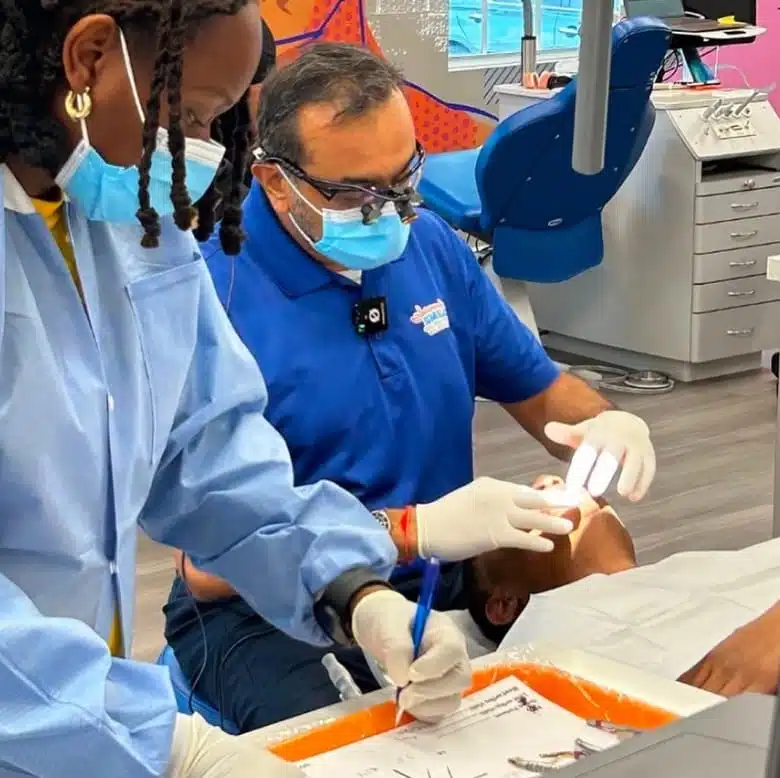
Even with diligent twice-daily brushing and flossing, children are uniquely susceptible to tooth decay in the back of their mouths. The anatomical pits and grooves of newly erupted permanent molars are often deeper and narrower than a single toothbrush bristle, turning them into natural food and plaque traps. According to the Centers for Disease Control and Prevention (CDC), dental sealants protect against 80% of cavities for two years after application and continue to shield teeth against 50% of cavities for up to four years.
At Jacaranda Smiles, our pediatric specialists across Plantation, Pembroke Pines, and Margate routinely utilize sealants as a foundational preventive therapy. Here is a clinical breakdown of how dental sealants work, when your child should receive them, and why they represent one of the most effective investments in long-term pediatric oral health.
What Are Dental Sealants and How Do They Work?
A dental sealant is an ultra-thin, biocompatible resin coating applied directly to the chewing (occlusal) surfaces of posterior molars and premolars. Rather than altering any underlying tooth enamel, the resin flows into microscopic fissures (developmental pits and grooves) and hardens under a specialized curing light.
Clinically, sealants act as a physical impermeable barrier. They smooth over irregular biting contours, preventing fermentable carbohydrates, cariogenic bacteria (like Streptococcus mutans), and acidic byproducts from accumulating in deep grooves that even thorough brushing cannot reach.
Optimal Clinical Timing: When Should Kids Get Sealants?
The protective value of sealants is maximized when placed shortly after the permanent molars emerge, before bacterial biofilm can initiate subsurface demineralization:
- First Permanent Molars (Ages 6 to 7): The “six-year molars” erupt behind the baby teeth without replacing any primary teeth. Because these teeth are permanent anchors for your child’s bite, sealing them as soon as they are fully erupted is essential. This also coincides with the ideal window for an initial orthodontic evaluation by age seven to monitor eruption patterns and arch spacing.
- Second Permanent Molars (Ages 11 to 13): The “twelve-year molars” erupt further back in the dental arch behind the first molars, presenting another set of deep occlusal pits vulnerable to adolescent dietary habits.
- High-Risk Primary (Baby) Molars: In select cases where a young child exhibits deep fissures or elevated caries risk, our pediatric dentists may recommend sealing primary molars to preserve spacing and prevent premature tooth loss.
Step-by-Step Clinical Application: Pain-Free and Drill-Free
One of the primary advantages of dental sealants is that the procedure is 100% non-invasive. There is no drilling, no removal of sound tooth structure, and no local anesthetic injections required:
- Surface Prophylaxis: The tooth is polished with an abrasive paste and thoroughly cleaned to remove all food debris, plaque, and pellicle from deep fissures.
- Isolation & Moisture Control: The molar is isolated with cotton rolls or a dry field isolation system, as enamel must remain completely dry for optimal bond strength.
- Enamel Conditioning (Etching): A mild etching gel is applied to the occlusal grooves for 15 to 20 seconds. This creates microscopic porosities in the enamel to mechanically anchor the resin.
- Rinsing & Drying: The conditioning gel is rinsed off, and the tooth is thoroughly air-dried until it shows a frosty white appearance.
- Resin Placement & Light Curing: The liquid sealant material is carefully painted into the pits and fissures. A specialized LED blue curing light is positioned over the tooth for 20 to 30 seconds to polymerize and instantly harden the resin.
- Occlusal Check: The pediatric dentist verifies the child’s bite with articulating paper to confirm normal biting contacts.
Dental Sealants vs. Fluoride: A Complementary Defense
| Feature | Dental Sealants | Fluoride Treatments |
|---|---|---|
| Mechanism | Physical impermeable barrier over grooves | Chemical remineralization (fluorapatite) |
| Primary Target Area | Deep chewing surfaces of molars/premolars | All smooth enamel surfaces throughout mouth |
| Application Frequency | Once every 3 to 5+ years (inspected biannually) | Every 3 to 6 months at routine cleanings |
| Invasiveness | Completely non-invasive, no numbing | Topical varnish applied in seconds |
Sealants and fluoride are not an “either/or” choice. While sealants protect deep, hard-to-clean chewing grooves, topical fluoride strengthens the smooth front, back, and interproximal surfaces between teeth. Pair these clinical solutions with our complete cavity prevention guide to establish robust daily habits at home.
Frequently Asked Questions About Dental Sealants
Can sealants be placed if my child has extreme dental anxiety?
Yes. Because sealants require zero drilling, scraping, or numbing needles, they serve as an ideal confidence-building visit for nervous children. Our pediatric team uses proven Tell-Show-Do techniques—read our guide on how to handle your child’s fear of the dentist. For children with severe phobias or sensory triggers, explore whether sedation dentistry is right for your child.
What happens if a sealant chips or falls off?
Sealants are durable enough to withstand normal chewing forces for 3 to 5 years or longer. However, sticky candies, ice chewing, or severe nighttime grinding can occasionally dislodge a margin. During routine six-month checkups, our pediatric dentists examine all sealant margins and can easily touch up or replace missing resin in minutes. If sudden enamel trauma or fractures occur, follow our triage protocol on how to treat your child’s dental emergency.
Do dental sealants contain BPA?
Modern pediatric sealants are either 100% BPA-free or contain trace amounts so minute that the American Dental Association (ADA) confirms exposure levels are hundreds of times lower than breathing ambient urban air. Dental sealants are completely safe, biocompatible, and endorsed by both the ADA and the AAPD.
Why choose a pediatric dentist for sealant placement?
Sealant longevity depends heavily on moisture isolation during application. Pediatric dentists possess specialized equipment and behavioral management training tailored to small mouths, energetic tongues, and high saliva flow rates. Learn more about how a children’s dentist is different from a regular dental professional.
Can sealants prevent gum issues as well?
Sealants primarily target chewing-surface enamel caries. To protect soft periodontal structures, maintain daily interdental cleaning and learn how to tell if your child is suffering from gum disease early on.
Proactive Preventive Dentistry in Broward County
Preventing decay before it starts protects your child’s natural tooth structure, prevents emergency visits, and helps avoid premature tooth loss that can cause complex bite misalignments. Jacaranda Smiles provides comprehensive pediatric dentistry and orthodontic evaluations across our South Florida locations in Plantation, East Pembroke Pines, West Pembroke Pines, and Margate.
Protect your child’s molars with durable, pain-free sealants. Call our team today at (954) 866-1995 or schedule an appointment online.